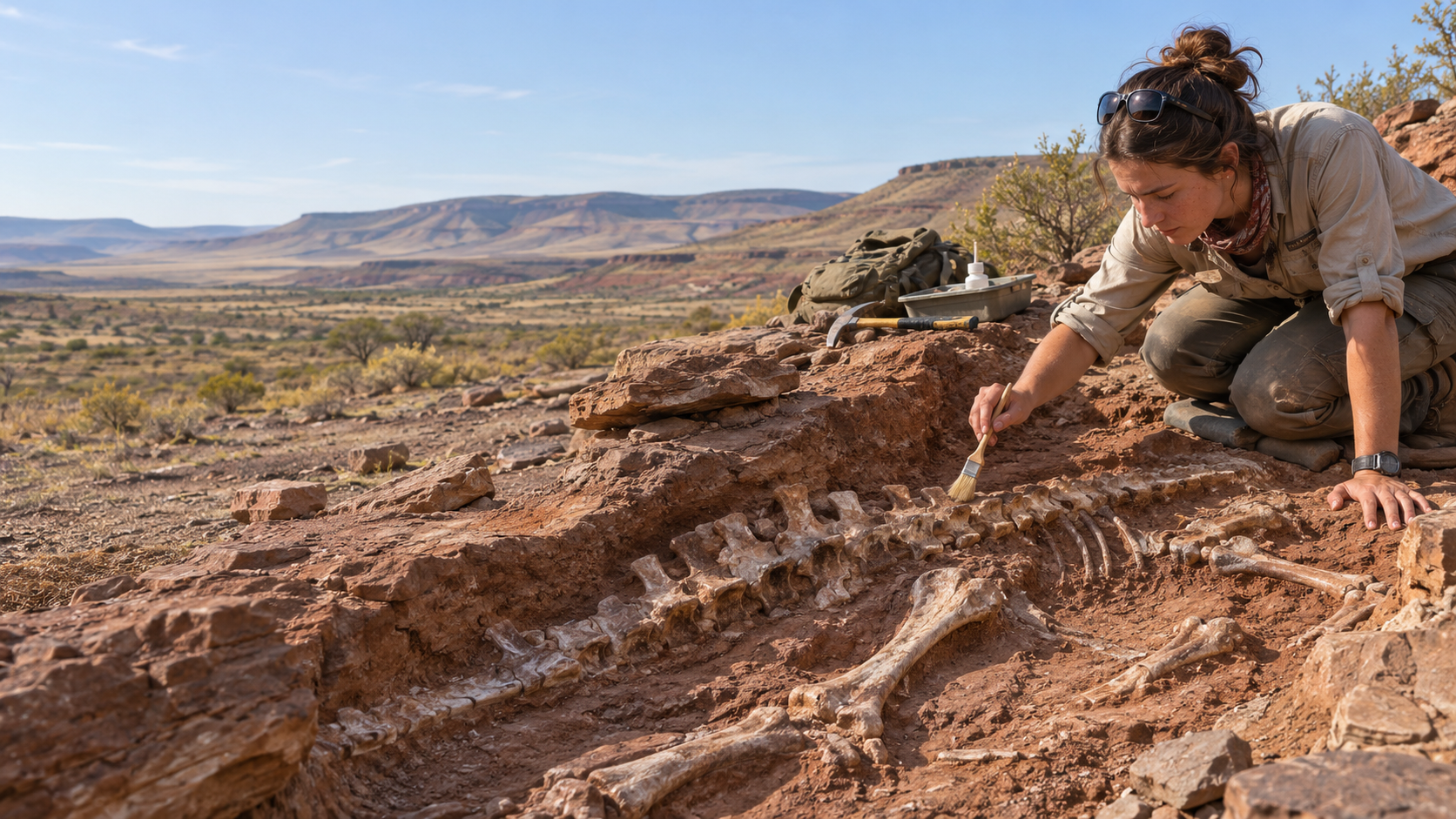
A Vanished Geological Signal from 2.5 Billion Years Ago
A Vanished Geological Signal from 2.5 Billion Years Ago
A chemical fingerprint appears to have disappeared from the rock record approximately 2.5 billion years ago. Scientists interpret the change as a possible sign of a major transition in how Earth’s crust and mantle interacted.
The finding matters because chemical evidence preserved in ancient rocks suggests that modern plate tectonics may have become established around the same period. Plate tectonics is the global system in which rigid pieces of Earth’s lithosphere move, collide, separate, and sink into the mantle.
The evidence does not identify a precise date when plate tectonics began. Instead, it points to a broad geological transition. Earlier forms of crustal movement may have existed, while a persistent, globally connected system developed later.
Available reports describe the signal only as a chemical fingerprint. They do not identify the exact element, isotope, mineral, or laboratory method involved. That limitation makes the finding a promising clue rather than conclusive proof.
What Was the Geological Fingerprint?
A geological fingerprint is a distinctive chemical or isotopic pattern preserved in a rock or mineral. Geologists use such patterns to reconstruct the conditions under which geological materials formed.
A chemical signature can reflect:
- The temperature and pressure of rock formation.
- The source of molten material.
- Interactions between the crust and mantle.
- The presence of water.
- The composition of ancient oceans or the atmosphere.
- The recycling of surface material into Earth’s interior.
The term “fingerprint” is descriptive. It does not refer to a literal mark or visible pattern. It means that a particular combination of elements or isotopes can identify a geological process.
When a signal disappears from younger rocks, several explanations are possible. The process that created it may have stopped, a new process may have become dominant, or later heating, pressure, melting, or alteration may have destroyed the signal.
Disappearance does not necessarily mean that the relevant material vanished from Earth. It may mean that the conditions required to produce or preserve the fingerprint changed.
How Ancient Rocks Preserve Earth’s History
Ancient rocks act as geological archives. Minerals can preserve elemental and isotopic ratios from the time they formed, even when the surrounding landscape has changed dramatically.
Researchers compare rocks from different ages to identify long-term changes in Earth’s systems. If a chemical pattern appears repeatedly in older rocks but becomes absent from younger ones, the timing may indicate a shift in geological conditions.
The oldest rocks are difficult to study because much of Earth’s original crust has been destroyed or transformed by:
- Erosion and weathering.
- Metamorphism caused by heat and pressure.
- Melting within the mantle.
- Burial beneath younger formations.
- Continental movement and collision.
- Recycling through subduction.
The geological record is therefore incomplete. Scientists rarely observe a continuous sequence spanning billions of years. Instead, they assemble a timeline from surviving fragments found in different regions.
A typical investigation involves dating rocks from different periods, measuring their elemental and isotopic compositions, comparing older and younger samples, and testing when a recurring chemical signal weakened or disappeared. Researchers must also determine whether the pattern formed when a rock crystallized or appeared later through fluids, heating, deformation, weathering, or contamination.
Why 2.5 Billion Years Ago May Have Been a Turning Point
Early Earth was hotter than today. Its mantle contained more internal heat, and its crust may have behaved differently from the rigid plates that dominate the modern planet.
Scientists distinguish among several levels of tectonic activity, including localized crustal deformation, intermittent movement of crustal blocks, regional or short-lived subduction, episodic tectonic activity, and a persistent global plate system.
This distinction is important. Earth’s crust may have moved before modern plate tectonics became established. The first movement of the crust is not necessarily the same as the beginning of a self-sustaining global system.
Around 2.5 billion years ago, Earth may have undergone a major reorganization of its crust and mantle. The reported chemical changes are consistent with this interpretation, although they do not prove it.
Modern plate tectonics includes:
- Subduction: One plate sinks beneath another into the mantle.
- Seafloor spreading: New oceanic crust forms as plates separate.
- Continental collision: Landmasses converge and build mountain belts.
- Transform motion: Plates slide horizontally past one another.
- Crustal recycling: Old surface material returns to Earth’s interior.
A globally integrated system connects the surface, crust, mantle, atmosphere, and oceans. Subduction can carry oceanic crust, sediments, water-bearing minerals, and surface-derived elements into the mantle. Later melting and volcanic activity can return chemically altered material toward the surface.
The Link Between the Fingerprint and Plate Tectonics
Plate tectonics is more than a system of moving rocks. It is a planetary-scale exchange mechanism.
Subduction moves surface materials into the mantle. These materials may contain water, sediments, altered oceanic crust, and elements concentrated by weathering or biological activity. Once incorporated into the mantle, they can influence the composition and melting behavior of later magmas.
Volcanic activity transports some of that material back toward the surface. Over long periods, this cycle links the atmosphere, oceans, continental crust, oceanic crust, and mantle.
Several processes could explain why a chemical fingerprint disappeared:
- A change in mantle chemistry: Melting and crystallization may have redistributed particular elements.
- The end of an early melting process: A mechanism common on hotter early Earth may have become less important.
- Widespread crustal recycling: Subduction may have altered the chemical balance of the crust and mantle.
- Changes at the surface: Shifts in the atmosphere, oceans, or weathering may have changed the material entering the mantle.
- Later geological alteration: Metamorphism or contamination may have erased the original signal.
The disappearance could therefore indicate a transition rather than a simple absence. One geological regime may have given way to another.
What the Evidence Suggests About Plate Tectonics
The central interpretation is cautious: chemical evidence in ancient rocks points to the possible establishment of modern plate tectonics approximately 2.5 billion years ago.
This interpretation could:
- Narrow the possible timeline for global plate recycling.
- Add chemical evidence to structural and geological observations.
- Help explain how Earth’s crust and mantle became more strongly connected.
However, “began” should not be interpreted as the first time any crust moved. It may refer to the point when a modern, persistent, and broadly integrated tectonic system became established.
Scientists also study early plate tectonics through deformed and metamorphosed rocks, ancient mountain belts, high-pressure minerals, volcanic-rock chemistry, evidence of ancient subduction, continental reconstructions, and computer models of mantle convection.
Chemical evidence is valuable because it can reveal surface–mantle interactions that are not always visible in rock structures. No single evidence type can resolve every question about early Earth. The strongest conclusion will come when chemical patterns agree with structural evidence, reliable age estimates, and geodynamic models.
Why the Start Date Remains Debated
Researchers propose different dates for the origin of plate tectonics because the early geological record is incomplete and the term can describe different stages of development.
Possible interpretations include:
- Plate tectonics began very early in Earth’s history.
- Early tectonic movement was episodic.
- Plate-like behavior developed independently in different regions.
- Localized subduction preceded global plate integration.
- A persistent modern system formed much later.
The 2.5-billion-year estimate represents one interpretation of chemical evidence, not a universally accepted date.
Ancient rocks present several challenges. Many have been destroyed or recycled, surviving samples may have experienced intense metamorphism, and available material often comes from a limited number of regions. Dating methods have uncertainty ranges, similar chemical signals can result from different processes, and later fluids can alter original mineral compositions.
A fingerprint may appear to disappear globally, or it may simply be absent from the particular samples studied. More rocks from different continents and geological settings are needed to test the interpretation.
Earth’s Broader Geological Transformation
If modern plate tectonics became established near this period, it would have changed how Earth formed and destroyed crust. Plate tectonics acts as a planetary recycling engine that influences:
- The growth of continents.
- The destruction of oceanic crust.
- Mantle circulation.
- Volcanic activity.
- Mountain building.
- Mineral distribution.
- Chemical exchange between the surface and interior.
Tectonics can also influence the long-term carbon cycle. Volcanic activity releases carbon dioxide, while weathering and sediment burial remove carbon from the atmosphere. Subduction carries some carbon-bearing material into the mantle, and volcanism can return it.
These processes may affect ocean chemistry, nutrient availability, climate regulation, continental weathering, and the development of habitable environments. The vanished fingerprint does not, by itself, prove that it caused any particular atmospheric or biological event.
The proposed transition also does not establish when life began. The formation of Earth, the emergence of life, the development of modern plate tectonics, and the rise of oxygen-rich conditions are separate timelines.
How Researchers Can Test the Interpretation
Scientists can test the proposed timeline by analyzing additional samples older and younger than 2.5 billion years. Key questions include:
- Does the fingerprint appear consistently in older rocks?
- Does it disappear in younger rocks from multiple continents?
- Does the transition occur in different rock types?
- Could local geological conditions explain the pattern?
- Do samples from separate tectonic environments show the same change?
A signal that changes consistently across regions would provide stronger evidence for a global transition.
Researchers can also examine multiple elements and isotope systems. Agreement among independent indicators would make the tectonic interpretation more persuasive. Analyses must account for original mineral composition, metamorphic alteration, weathering, contamination, sampling bias, and later fluid movement.
Computer models can test whether proposed crust and mantle processes produce the observed chemical changes. Models of stagnant-lid behavior, episodic tectonics, localized early subduction, and a globally connected plate system can be compared with chemical data, rock structures, geochronology, and geodynamic behavior.
What This Discovery Does—and Does Not—Prove
The reported evidence supports the possibility that:
- A major geological transition occurred around 2.5 billion years ago.
- Ancient rocks preserve a chemical record of that transition.
- Modern plate tectonics may have become established during this period.
- Crust–mantle recycling became more extensive or persistent.
- Earth’s geological systems became increasingly interconnected.
The available summaries do not identify the exact element, isotope, or mineral involved. They also do not provide the research team, publication date, precise rock formations, analytical method, statistical confidence, or evidence showing whether the fingerprint disappeared globally or only within the studied samples.
Those details require verification through the original scientific publication. The headline claim should therefore be presented as a significant hypothesis supported by chemical evidence, not as a final resolution of the debate.
Conclusion
A chemical fingerprint in ancient rocks may have disappeared approximately 2.5 billion years ago. Its timing aligns with evidence suggesting that modern plate tectonics became established during the same broad period.
The finding is important because chemical evidence can reveal interactions among Earth’s surface, crust, and mantle even when direct geological structures have been destroyed.
The proposed transition may represent a shift from an earlier, less integrated tectonic regime to a global recycling system involving subduction, mantle circulation, crust formation, and volcanic activity.
The fingerprint is an important clue, not definitive proof of a precise starting date. Confirming its origin and meaning will require more ancient samples, independent chemical tests, improved dating, and models that connect geochemistry with plate dynamics.
Frequently Asked Questions
What geological fingerprint vanished 2.5 billion years ago?
Available reports describe a chemical fingerprint preserved in ancient rocks that appears to disappear around 2.5 billion years ago. They do not specify the exact element, isotope, compound, or mineral involved.
Does this prove that plate tectonics began exactly 2.5 billion years ago?
No. The evidence suggests that modern plate tectonics may have become established around that time. It does not prove that all tectonic activity began on one precise date.
Why are ancient rocks useful for studying plate tectonics?
Ancient rocks can preserve chemical and isotopic information from the time they formed. These signatures may reveal interactions among the crust, oceans, atmosphere, and mantle.
What is the difference between early tectonic activity and modern plate tectonics?
Early tectonic activity may have been localized, intermittent, or driven by processes unlike those operating today. Modern plate tectonics involves a persistent global system of moving lithospheric plates, including subduction, seafloor spreading, continental collision, transform motion, and crustal recycling.
Why does the origin of plate tectonics matter?
Plate tectonics shapes continents, recycles crust, builds mountains, drives volcanic activity, and influences the long-term carbon cycle. Its development may also have helped maintain environmental conditions favorable to life over geological timescales.
Is the 2.5-billion-year date universally accepted?
No. Scientists continue to debate when modern plate tectonics began because much of Earth’s early rock record has been destroyed, altered, or recycled. The estimate should be evaluated alongside structural, geochronological, and geodynamic evidence.