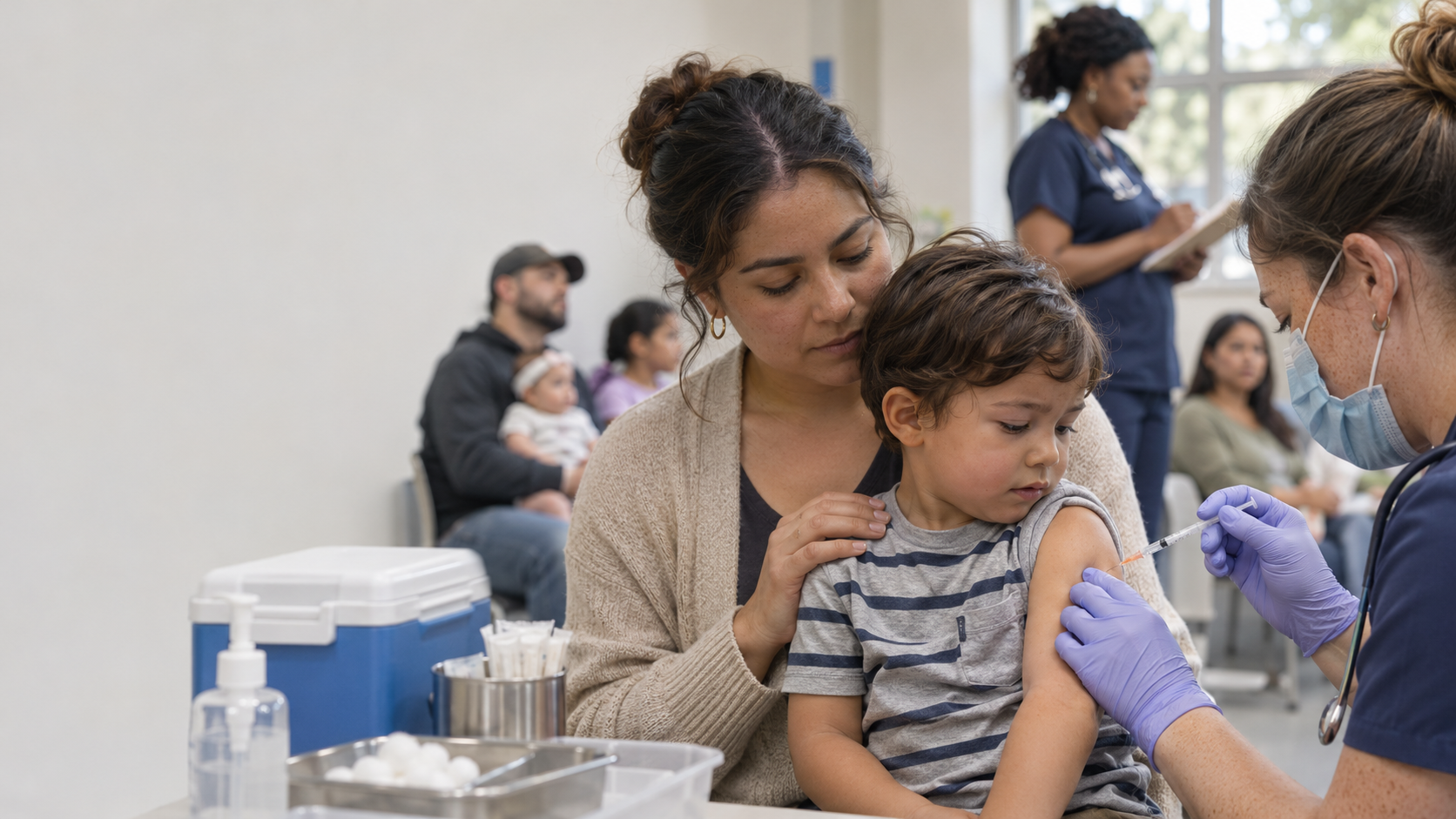
U.S. Measles-Elimination Status at Risk: What It Means
U.S. Measles-Elimination Status at Risk: What It Means
Renewed outbreaks and continued domestic transmission are putting the United States’ measles-elimination achievement at risk. Reports from PBS and USA Today describe the country as approaching, or potentially losing, its elimination designation. Bloomberg and STAT place the development within a broader North American and regional concern. Source 1 Source 3
This is more than a technical change in public-health terminology. Measles elimination means that sustained domestic transmission has been interrupted. Losing that status would indicate that imported infections are again finding conditions for continued spread inside the country.
What Measles Elimination Means
Elimination Is Not Eradication
Measles elimination means a country or region has interrupted continuous, sustained transmission. It does not mean imported cases are impossible. Travelers can still bring measles into a country where the disease has been eliminated.
The critical question is what happens after introduction. If officials identify cases quickly, trace contacts, vaccinate susceptible people, and stop further spread, elimination can be maintained. If infections continue passing through communities over time, authorities may determine that elimination has not been sustained.
Eradication is a higher global standard. It requires worldwide interruption of measles transmission. Elimination applies to a specific country or region; eradication applies to the entire world.
Why the Designation Matters
The designation reflects decades of vaccination, disease surveillance, laboratory testing, case investigation, and rapid outbreak response. It shows that sustained transmission can be interrupted even while the virus continues circulating internationally.
Measles is highly contagious. It can spread rapidly in schools, childcare centers, healthcare settings, households, and communities with low vaccination coverage. Maintaining elimination therefore requires strong routine immunization and effective outbreak response.
The United States’ earlier achievement depended on:
- High routine childhood vaccination coverage.
- School-entry immunization requirements.
- Accessible pediatric and primary-care services.
- Laboratory confirmation and case reporting.
- Contact tracing and exposure notification.
- Rapid vaccination during outbreaks.
- High community immunity.
Elimination was never permanent. It required continuous maintenance.
Why the United States Is at Risk
Renewed Domestic Transmission
The current concern involves more than isolated imported cases. The central issue is whether measles has continued spreading domestically for long enough to meet the definition of sustained transmission.
USA Today describes the United States as facing the possibility of losing its designation, while PBS reports that the country is nearing that point. Source 1 Source 3
Reports describing the United States as “at risk” or “on the verge” should not automatically be treated as confirmation that the designation has already been withdrawn. The formal assessment must consider the duration, continuity, and epidemiological links among cases.
More Than 2,000 Reported Cases in 2025
Forbes reports that U.S. measles cases exceeded 2,000 in 2025. Source 9
A high case count creates more opportunities for transmission and places additional pressure on health departments, laboratories, hospitals, schools, and healthcare providers. However, case totals alone do not determine whether elimination has been lost. Authorities must examine whether cases are linked, whether transmission has continued domestically, and whether outbreak chains have been interrupted.
Outbreaks in the United States and Canada
The United States and Canada face a shared North American challenge. Bloomberg reports that both countries are approaching an unwelcome milestone as outbreaks continue. Source 5
Frequent cross-border travel allows infections to move between countries. An imported case may cause limited transmission in a highly immunized community, but risk increases when susceptible people are concentrated in schools, neighborhoods, religious communities, or other social networks.
A Threat to the Wider Americas
STAT reports that the Americas, with Canada at the center of current concern, are close to losing their measles-elimination status. Source 7
Regional elimination depends on sustained control across participating countries. Cross-border movement, tourism, migration, and international travel make isolated national strategies insufficient.
What Is Driving the Resurgence?
Local Immunity Gaps
Measles spreads most easily where vaccination coverage is uneven. A strong national average can conceal communities with substantially lower protection. Clusters of unvaccinated or under-vaccinated people can sustain transmission after a single imported case.
Gaps may result from missed appointments, access barriers, delayed vaccination, exemptions, misinformation, or disrupted healthcare services. Two-dose coverage should be evaluated at local, state, and regional levels rather than through national averages alone.
Disrupted Routine Vaccination
Missed medical appointments, reduced access to preventive care, staffing shortages, and interruptions in school or community programs can weaken routine immunization. Catch-up campaigns can address these gaps when agencies work with schools, pediatric practices, pharmacies, and community organizations.
Imported Cases and Travel
Imported cases are not, by themselves, proof that elimination has ended. The risk begins when an imported infection generates sustained local transmission. Early diagnosis, laboratory testing, contact tracing, and rapid vaccination are essential after a suspected case is identified.
Misinformation and Hesitancy
Vaccine misinformation and declining confidence can contribute to lower uptake, but they should be considered alongside access barriers, healthcare disruption, and local coverage patterns. Effective communication should address concerns directly without stigmatizing communities affected by outbreaks.
What Losing Elimination Status Would Mean
Losing the designation would mark a major public-health setback and indicate that sustained domestic transmission had returned. It would also signal weaknesses in population immunity, surveillance, or outbreak-control capacity.
Health departments would face greater demands for:
- Case investigation and laboratory confirmation.
- Contact tracing and exposure notifications.
- Isolation guidance and vaccination clinics.
- Catch-up immunization and public communication.
- Monitoring for additional cases.
Infants too young for routine vaccination, immunocompromised people, and others who cannot receive certain vaccines would face heightened risk. Community immunity helps protect these groups by reducing transmission.
A lost designation could also weaken public confidence and create confusion about elimination. Elimination is not a permanent guarantee; it is an achievement that requires continuous maintenance.
How to Rebuild Measles Protection
Increase Routine Vaccination
Routine vaccination remains the primary strategy for preventing outbreaks. Schools, pediatric practices, pharmacies, and local health departments can improve access through convenient appointments, reminder systems, mobile clinics, and catch-up programs.
Close Local Immunity Gaps
Health departments should use vaccination and surveillance data to identify areas with low coverage and direct resources there. Outreach should provide practical assistance rather than blame.
Strengthen Surveillance and Response
An effective response should:
- Identify suspected measles cases.
- Confirm infections through appropriate testing.
- Trace close contacts.
- Notify people who may have been exposed.
- Offer vaccination or other appropriate measures.
- Monitor contacts for additional transmission.
Speed matters because measles can spread before officials understand the outbreak’s full scale.
Improve Communication and Coordination
Public-health agencies should explain what elimination means, why imported cases can still occur, and how vaccination protects individuals and communities. Authorities should report case totals, outbreak locations, and response measures transparently without stigmatizing affected communities.
U.S. measles control is connected to Canadian and regional control. Cross-border information sharing, compatible surveillance systems, coordinated vaccination efforts, and consistent outbreak protocols can reduce continued transmission.
How to Interpret the Current Status
The supplied reporting uses different formulations: PBS describes the United States as on the verge of losing its status; USA Today says it could lose the designation; Bloomberg describes a shared U.S.-Canada milestone; STAT reports broader regional concern; and Forbes links the situation to more than 2,000 reported U.S. cases in 2025. Source 1 Source 3 Source 9
Unless the responsible authority has formally withdrawn the designation, the most accurate descriptions are “at risk of losing measles-elimination status,” “approaching the threshold,” or “under assessment for sustained domestic transmission.”
Conclusion
Measles-elimination status means sustained domestic transmission has been interrupted. It does not mean imported cases are impossible or remove the need for vaccination, surveillance, and rapid outbreak response.
Renewed U.S. outbreaks threaten a landmark achievement and contribute to a wider regional problem involving Canada and the Americas. The warning concerns more than case totals. It points to immunity gaps, delayed detection, strained health departments, and weakened prevention.
The United States can defend or restore measles control by maintaining high vaccination coverage, identifying local gaps, responding rapidly to suspected cases, communicating reliable information, and coordinating with neighboring countries. Restoration would require documented interruption of sustained domestic transmission and continued performance over time.
Frequently Asked Questions
What does measles-elimination status mean?
It means a country or region has interrupted sustained domestic transmission. Imported cases can still occur; the key question is whether infections continue spreading locally over time.
Why could the United States lose the designation?
Renewed outbreaks and a high number of reported cases could indicate sustained domestic transmission. Authorities would need to assess the duration, continuity, and links among cases.
Does losing elimination status mean measles is out of control everywhere?
No. Risk varies by community. Some areas may have strong vaccination coverage, while local immunity gaps allow outbreaks elsewhere.
Can the United States regain elimination status?
Potentially. Authorities would need to document that sustained domestic transmission had been interrupted and maintain strong vaccination, surveillance, testing, and response systems.
Why does Canada’s situation matter?
Frequent travel and cross-border movement can introduce infections between the two countries. Coordinated surveillance and vaccination efforts are therefore important across North America.